When Michigan State University student Lucy Van Hof arrived in Monteverde, Costa Rica, in spring 2026, she expected to learn about community engagement and sustainability. Instead, her study abroad experience became an opportunity to immerse herself in a community navigating profound organizational change—and to use her academic training to help that community envision its future
In recognition of her work, Michigan State University’s Center for Global Learning and Innovation has nominated Van Hof for the Forum on Education Abroad’s Award for Academic Achievement Abroad for her research project, “Seeds of Change: John Paul Lederach’s Transformation Theory in Monteverde Quaker Friends Meeting.” The award recognizes outstanding academic work completed by students during education abroad, and the nomination highlights the depth of learning, community engagement and impact made possible through Van Hof’s experience in Costa Rica.
The nomination was supported by Vincent Delgado, faculty member in MSU’s Residential College in the Arts and Humanities and director of the Sustainability in Costa Rica program, who mentored Van Hof throughout her research.
For Van Hof, however, the significance of the project goes beyond an award.
It began with listening.
For three months, Van Hof immersed herself in Monteverde through MSU’s Civic Engagement and Sustainability in Costa Rica program, combining coursework, Spanish language learning and hands-on engagement with local communities.
Through Community Participatory Action Research, she learned to understand communities through their own strengths, needs and perspectives. Working with partners ranging from a girls’ advancement program to a coffee farm, she discovered that meaningful community engagement begins with humility.
That lesson shaped her final project with the Monteverde Quaker Friends Meeting, a community whose history dates to Quaker families who settled in Costa Rica in the 1950s. As the organization navigated an aging membership and changing community needs, Van Hof approached its challenges not as problems to be fixed, but as opportunities for transformation.
Drawing on peacebuilding scholar John Paul Lederach’s conflict transformation framework, she used oral histories, conversations and participatory approaches to explore how the Meeting could draw on its history, relationships and values to envision its future.
The title of Van Hof’s project—Seeds of Change—captures the approach she took. In her research, she compares organizational transformation to a “super bloom,” when the right environmental conditions allow something new to emerge. Change, she argues, does not necessarily happen through one dramatic decision. It can grow slowly from conditions that have been developing over time.
That perspective allowed Van Hof to look at the Friends’ challenges alongside their long history of innovation.
Rather than positioning organizational change as a departure from the community’s identity, she explored how new structures could help sustain the values that have defined the Friends for decades: simplicity, integrity, peace, community and equality.
Her research findings were shared with the Meeting’s Administration Committee and general membership through workshops designed to help members understand the organization’s current challenges and consider possibilities for its future.
For Van Hof, the process reinforced an important lesson: even when people speak the same language, meaningful communication can be difficult.
That realization became an important part of her research.
She began to see communication, relationships, history and even fear as interconnected elements of organizational change.
The impact of Van Hof’s project extended beyond the research paper.
According to Delgado, the Monteverde Friends began making significant organizational
changes following Van Hof’s work.
Within four months of her departure, the community had hired a new school director with a focus on organizational capacity and strategic management, engaged a fund developer to expand support for the community’s work around peace and the environment, and developed a general coordinator position intended to streamline administrative responsibilities.
Delgado, who has mentored more than 100 community participatory research and evaluation projects through education abroad programs, was particularly struck by Van Hof’s ability to bring together academic research, listening and reflection.
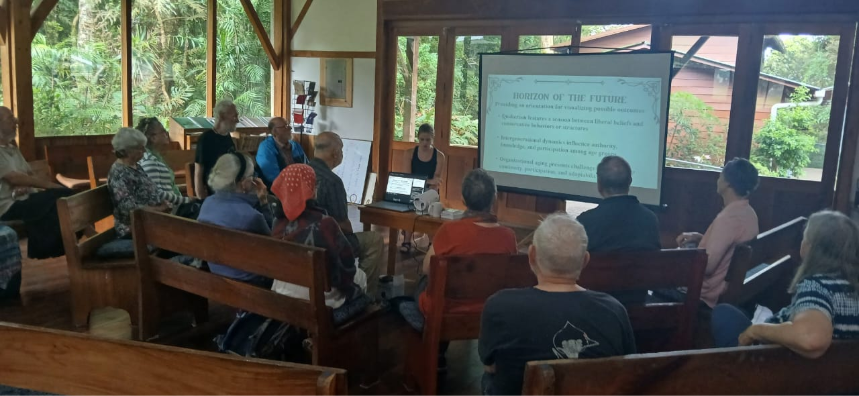
Van Hof entered the program hoping to explore how community building and understanding could translate into a future career.
She left with a more nuanced understanding of what it means to work with communities.
Her experience taught her that professional skills such as communication, leadership and organizational development cannot be separated from empathy, intentionality and an understanding of people’s lived experiences.
Her project illustrates what can happen when education abroad moves beyond observation and becomes a reciprocal process of learning and contribution.
In Monteverde, Van Hof was not simply studying a community from the outside. She became part of a conversation about its future—listening to generations of community members, applying academic frameworks to a real-world challenge, and helping create space for people to imagine what comes next.
The “seeds” were already there.
Through her global learning experience, Van Hof helped the community identify them, listen to one another, and begin considering how they might grow.
Student Stories
Perspectives from abroad
Global Learning EXPO
October 8, 2026
1 pm to 5 pm at Breslin Center

Program Search
Create your profile to begin searching programs
Advising
Questions about study abroad?
Walk-in and online advising available!



